A guest scans your menu in Bangkok, sees prices in euros, and pauses. Another guest opens the same menu in Mexico City and asks staff whether the symbol is wrong or whether the tourist menu is different. Meanwhile, a multi-country operator is copying the same menu structure across locations and patching currency symbols by hand because the software does not support the local format cleanly.
That is the real problem restaurant menu currencies solve. They are not decorative. They are a trust layer. If the menu shows the wrong local currency, global guests hesitate, staff waste time clarifying basic pricing, and operators end up managing workarounds instead of service.
For restaurants serving international travelers, expanding across borders, or building a more consistent digital guest experience, supported currencies for restaurant menus are part of the product, not a footnote.
What changed on April 20, 2026
On April 20, 2026, Kiuar.menu expanded supported restaurant menu currencies to 40.
This release added 16 new currencies to the existing catalog: ARS, BHD, CLP, COP, GEL, HKD, IDR, KHR, LAK, LKR, MXN, MYR, PHP, SGD, THB, VND.
That change matters because it turns Kiuar.menu into a more practical fit for a broader set of restaurants, countries, and global clients. Operators can now set the right local menu currency for more markets across Latin America, Southeast Asia, the Gulf region, and additional international destinations where guests expect to read prices in the currency they actually use day to day.
This update is specifically about menu currency support inside the restaurant product experience. It applies to the currency restaurants use for prices shown to guests. It does not mean subscription billing or plan pricing has expanded to the same set of currencies, and it should not be read that way.
Why restaurant menu currencies matter for global restaurants
Restaurant menu currencies affect guest confidence faster than most operators realize.
Guests do not usually stop to analyze a menu currency problem. They just feel that something is off. If the price format looks foreign for the venue they are standing in, they wonder whether the menu is outdated, whether taxes are missing, whether a conversion will happen later, or whether they are looking at the wrong version entirely.
That confusion slows service. Staff get pulled into low-value clarifications. Managers end up explaining whether the number is final. And if the restaurant serves travelers, hotels, airports, tourist zones, or mixed local-and-visitor traffic, that friction gets multiplied every shift.
This is why a multi-currency restaurant menu setup is not really about offering every currency to every guest. It is about assigning the right default local currency to each restaurant so the digital menu feels native the moment it opens.
For operators using global restaurant menu software across multiple markets, local currency support also protects consistency. You should not need one workflow for Europe, another for Southeast Asia, and a third for Latin America. You should be able to run the same publishing system and simply set the currency that matches each venue.
Where the new batch expands coverage
The jump from 24 to 40 supported restaurant menu currencies gives Kiuar.menu broader regional coverage where international restaurant operations often get blocked by smaller software limits.
In practical terms, the newly added currencies make the platform more useful for:
- restaurant groups opening or operating in Mexico, Argentina, Colombia, and Chile
- hospitality businesses serving guests in Singapore, Malaysia, Thailand, Vietnam, Indonesia, Cambodia, Laos, and Sri Lanka
- venues working in additional international markets such as Hong Kong, Bahrain, and Georgia
That matters for more than local ownership groups. It also matters for agencies, consultants, hotel operators, franchise systems, and other global clients helping restaurants launch digital menus in multiple countries. The moment you manage more than one region, QR menu currencies stop being a minor setting and become part of rollout feasibility.
The broader point is not “we support more codes now.” The broader point is operational reach. Kiuar.menu can now cover more real-world restaurant launches without forcing a venue onto the wrong local format or asking the team to compromise on pricing clarity.
How Kiuar.menu applies default currency across the guest experience
Digital menu currencies only help if they stay consistent wherever guests encounter prices.
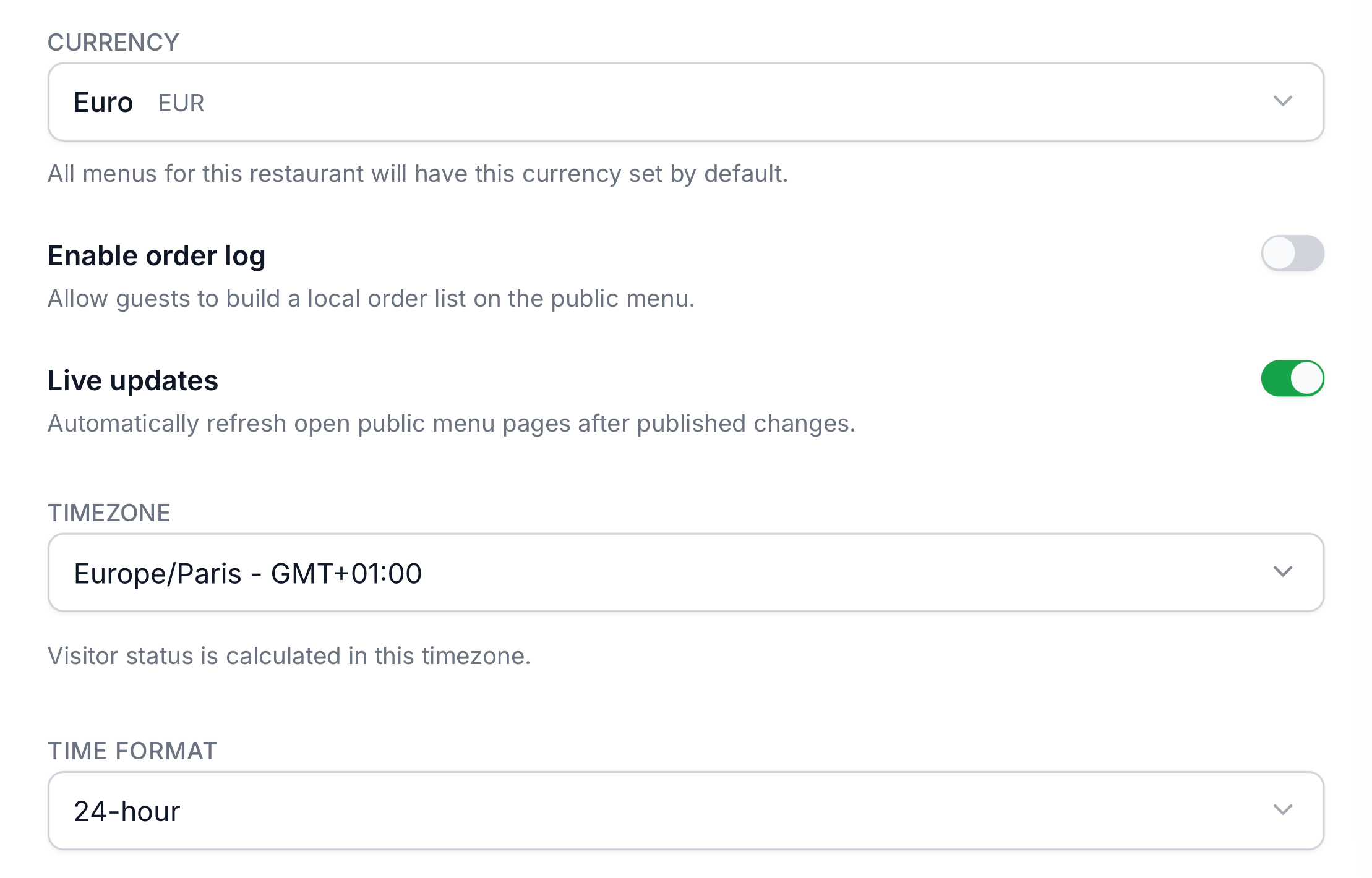
In Kiuar.menu, the default currency is set at the restaurant level. From there, that restaurant menu currency carries through the main pricing surfaces that operators actually need guests to trust:
- menu item prices
- cover charges
- guest-facing order summaries
That is the important operational behavior. The currency is not just a symbol floating beside one price field. It becomes the restaurant’s pricing context across the guest-facing experience.
This reduces the usual mismatch problem. If your menu shows one local currency, but the summary or extra charges show another format, guests notice immediately. A cleaner model is one source of truth: set the default once for the restaurant, then let the menu and its guest-visible pricing surfaces stay aligned.
For teams comparing digital menu currencies across platforms, this is a better test than the marketing page. Ask whether the currency setting actually applies where it matters, or whether you are just changing a label in one part of the interface and cleaning up the rest manually later.
Why this matters for multi-location and multilingual operations
Currency support gets more important as soon as an operator has more than one location or more than one guest language to serve.
Multi-location restaurants already deal with local variations in pricing, taxes, supplier costs, and menu structure. Add cross-border operations to that, and currency becomes part of the governance problem. If each venue cannot present pricing in the right local format, the “single system” starts breaking down into exceptions, staff notes, and duplicated menu maintenance.
This is where Kiuar.menu’s broader product direction matters. A restaurant can manage the right local currency alongside the same publishing workflow it uses for branding, updates, and guest-facing presentation. And if that same operator also serves international travelers, currency clarity works naturally alongside multilingual menus and localized guest flows.
If your operation depends on translated menus, this pairs directly with multi-language digital menus. Language helps guests understand the dish. Currency helps them trust the price. You usually need both.
If your challenge is rollout across brands, franchises, or several venues, this connects just as directly with multi-location QR menu management. The more locations you run, the less tolerance you have for one-off currency workarounds.
That is also why supported currencies for restaurant menus matter to global clients beyond restaurants themselves. The agencies and teams implementing menus at scale need predictable setup rules. “Set the restaurant currency correctly and publish” is a workflow. “Duplicate the menu and patch prices manually for each market” is a liability.
Choosing the right QR menu currencies strategy
Most restaurants do not need a guest-side currency switcher. They need the right default local currency from the start.
That is the practical strategy for a multi-currency restaurant menu in hospitality:
- choose the local operating currency for each restaurant
- keep the pricing display consistent across all guest-facing surfaces
- avoid manual symbol swaps or image-based menus that hide formatting problems
- make sure language, pricing, and operational updates live in the same publishing workflow
The better your QR menu currencies setup is, the less guests think about it at all. The menu simply feels right for the place they are in.
Restaurant menu currencies should not be a workaround problem
Restaurant menu currencies become visible only when they go wrong. That is why so many operators underestimate them until they expand into a new country, take on global clients, or start serving more international guests.
Kiuar.menu now supports 40 restaurant menu currencies, with the April 20, 2026 expansion adding 16 new options that make the platform practical for a broader range of countries and restaurant operations around the world. That gives operators a stronger base for local pricing clarity without changing the product into a patchwork of region-specific exceptions.
If you are evaluating restaurant menu currencies as part of a broader digital menu rollout, explore Kiuar.menu and review the FAQs. The right restaurant menu currencies setup should make pricing feel local, clear, and trustworthy from the first scan.