The restaurant industry in 2026 has moved far beyond the emergency measures of contactless dining. QR code menus are no longer just about safety — they’re sophisticated digital sales surfaces that drive revenue, streamline operations, and deliver actionable intelligence. The question isn’t whether your restaurant needs a digital menu, but which platform will deliver the best return on investment.
The stakes are higher than most operators realize. A poorly optimized menu that loads slowly or requires excessive zooming costs you orders. A static PDF sticker provides no data on what customers actually view or want. Meanwhile, the best platforms in 2026 function as real-time operational control centers — allowing you to update pricing instantly, hide sold-out items with a single click, and understand customer behavior across every location you operate.
This comprehensive review examines the leading QR menu platforms of 2026, with particular attention to the features that actually matter: speed, real-time control, analytics depth, and total cost of ownership. We’ll cut through the marketing noise to identify which tools deliver genuine operational value.
The 2026 QR Menu Landscape: What Changed
The market has undergone a fundamental shift. Early QR menu solutions were essentially PDF viewers with a code generator attached. In 2026, that approach is obsolete. Modern platforms are expected to provide:
- Instant synchronization across all locations when you change a price or availability
- Granular analytics showing exactly which items customers view, how long they spend on each section, and where they abandon
- True multi-language support that goes beyond simple translation to localized currency and cultural preferences
- Integration capabilities with POS systems to eliminate double-entry and sync inventory automatically
- Brand-consistent design that doesn’t scream “cheap tech solution” to your guests
The divide between legacy platforms and next-generation tools has never been clearer. Let’s examine where each major player stands.
Top Rated QR Menu Generators Reviewed
TableQR
TableQR deserves credit for understanding early that digital menus would primarily be viewed on smartphones. Their interface is genuinely mobile-optimized, not just a desktop site squeezed onto a smaller screen.
Strengths:
- Exceptional loading speed on 4G and 5G networks
- Clean, distraction-free interface that keeps focus on menu items
- Strong emphasis on visual hierarchy and branding consistency
- Reliable uptime and performance during high-traffic periods
Limitations:
- Pricing structure scales aggressively with location count
- Analytics capabilities are basic compared to newer platforms
- Limited native integrations with modern POS systems
- Multi-language support exists but requires manual setup for each language variant
Best For: Single-location fine dining establishments where brand presentation is paramount and budget constraints are minimal.
Kiuar.menu: The 2026 Game-Changer
Kiuar.menu entered the market with a provocative thesis: QR menu software has been overcomplicated and overpriced. They’ve built an all-in-one platform that delivers enterprise-grade functionality at a price point that disrupts the entire market.
Pricing That Redefines Value: At $2.99/month or $27.99/year (2.49€/month or 23.99€/year), Kiuar.menu costs less than a single entrée at most restaurants. Compare this to competitors charging $50-$200 monthly per location, and the value proposition becomes undeniable. There are no complex tiers, no feature gates, no surprise charges as you scale.
Core Capabilities: The platform delivers comprehensive functionality that rivals tools costing 10–20 times more:
- Unlimited Everything: No caps on locations, menus, items, languages, or menu updates. Build 5 restaurants with 10 menus each, or 50 locations with standardized offerings — same price.
- 29-Language Support: True multilingual capability covering major global languages with proper localization, not just word-for-word translation. This positions Kiuar.menu as the strongest international solution in the market.
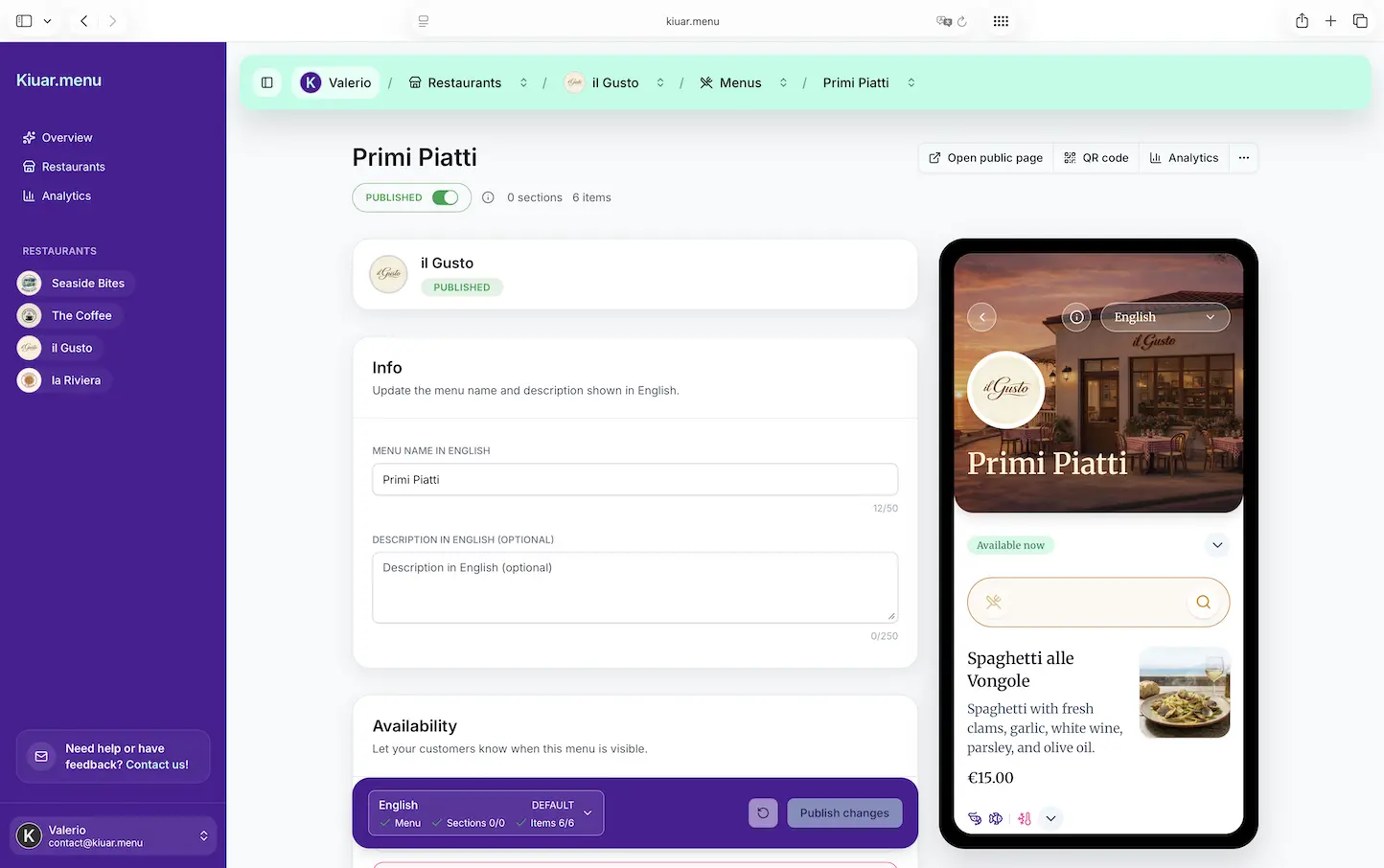
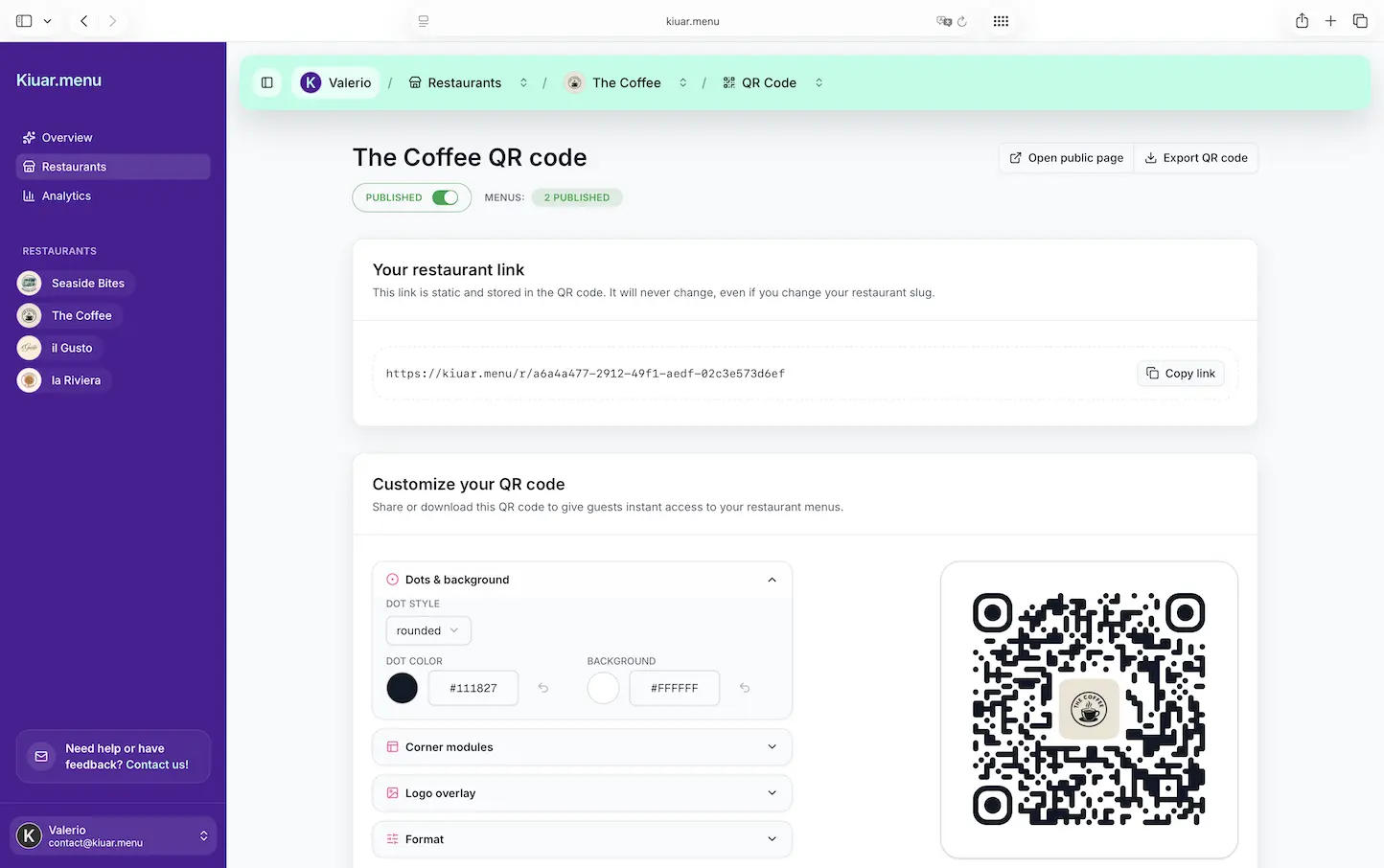
- Brand-First Customization: Full control over colors, fonts, layouts, and visual hierarchy. Your menu reflects your brand identity without the “cheap digital menu” aesthetic that plagues many platforms.
- Real-Time Control: Update prices, descriptions, availability, or add new items instantly across all locations. The “86 it” test — hiding a sold-out item in seconds — is effortless.
- Professional Templates: Pre-built layouts for every venue type from fine dining to food trucks, customizable to match your specific needs.
The Analytics Revolution:
Where Kiuar.menu truly separates from the pack is analytics depth. Most competitors provide basic view counts. Kiuar.menu delivers three-tiered intelligence:
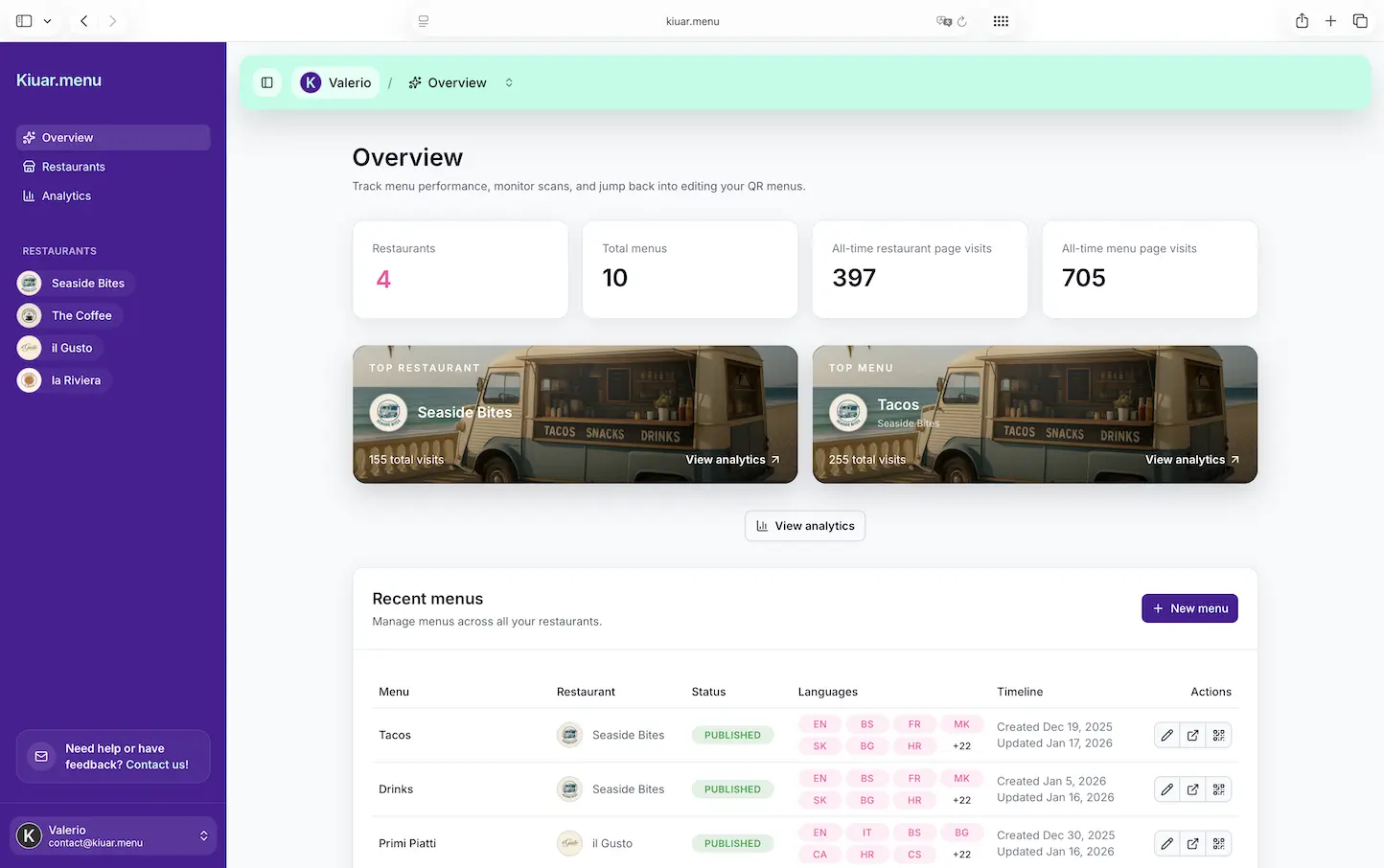
1. Account Level Analytics: Enterprise operators see performance across their entire portfolio. Which locations drive the most engagement? Where are customers spending the most time? Which menu items generate interest across all properties? This bird’s-eye view enables strategic decisions about menu engineering, pricing strategy, and location performance.
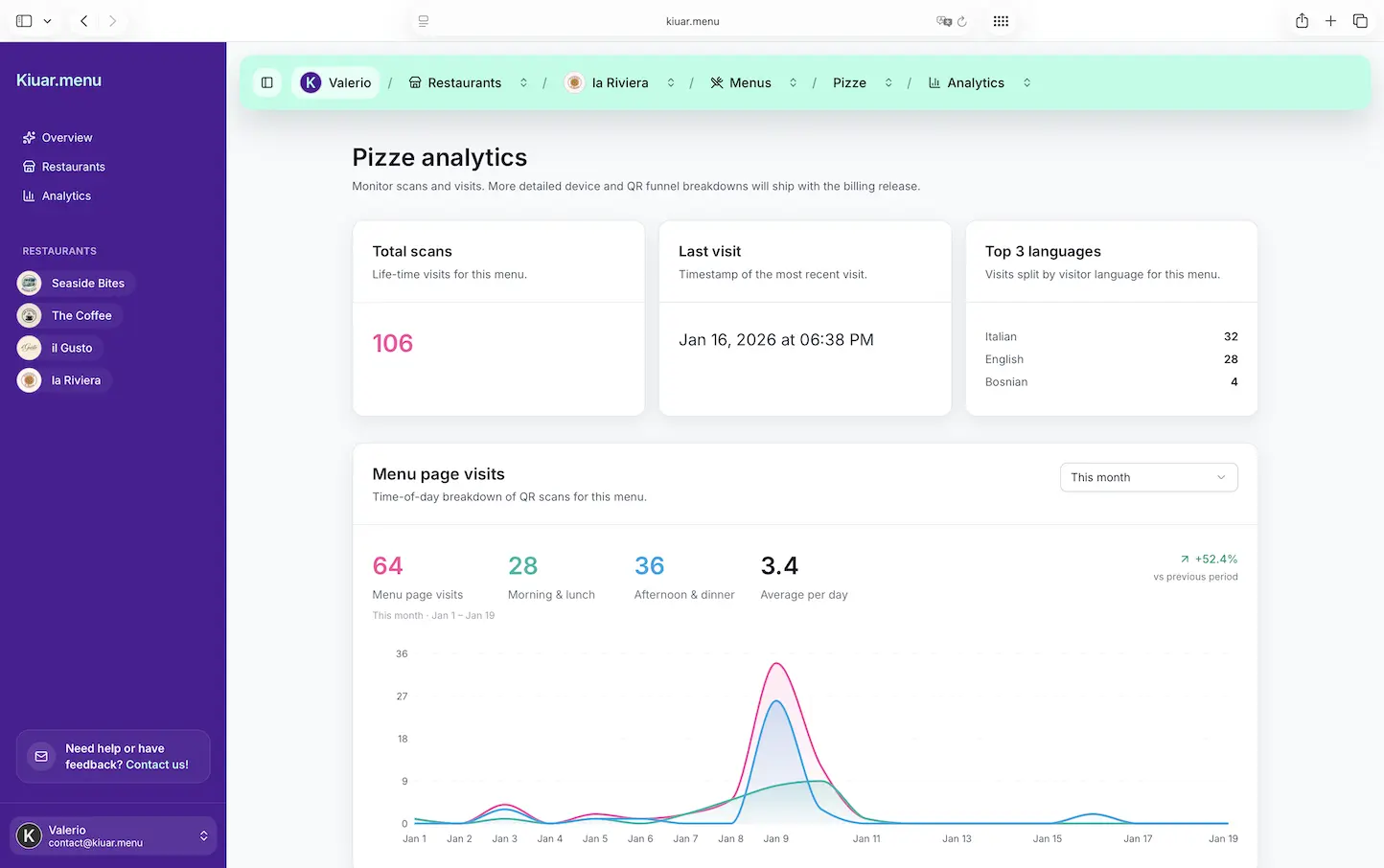
2. Restaurant Level Analytics: Individual location managers access data specific to their venue. Peak viewing times, popular categories, customer navigation patterns, and session duration reveal operational insights. Identify which items customers examine but don’t order — signals of pricing concerns or unclear descriptions.
3. Menu Level Analytics: The most granular view tracks performance of individual menus within a location. Your lunch menu versus dinner menu. Seasonal specials versus core offerings. Wine list engagement versus cocktail menu views. This precision enables continuous optimization based on actual customer behavior rather than assumptions.
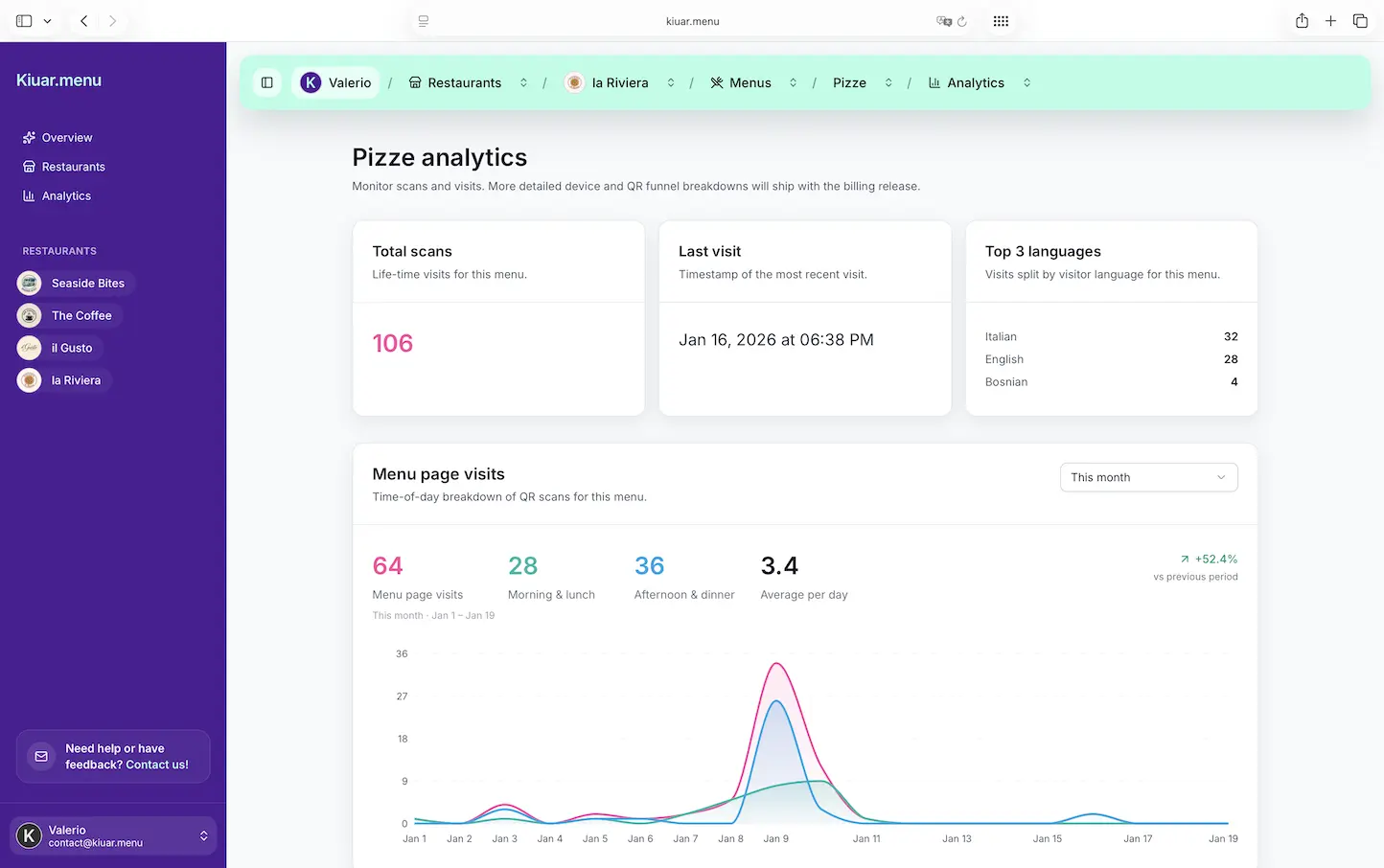
This three-tiered approach solves the fundamental challenge of restaurant data: corporate needs strategic visibility while location managers need tactical insights. Kiuar.menu delivers both without forcing users to navigate complex dashboards or export data into spreadsheets.
Multi-Location Excellence:
For restaurant groups, Kiuar.menu’s governance model is transformative. Corporate teams update brand standards, pricing, or item descriptions once — changes propagate instantly across every location. Individual managers retain control over location-specific items, daily specials, or availability status.
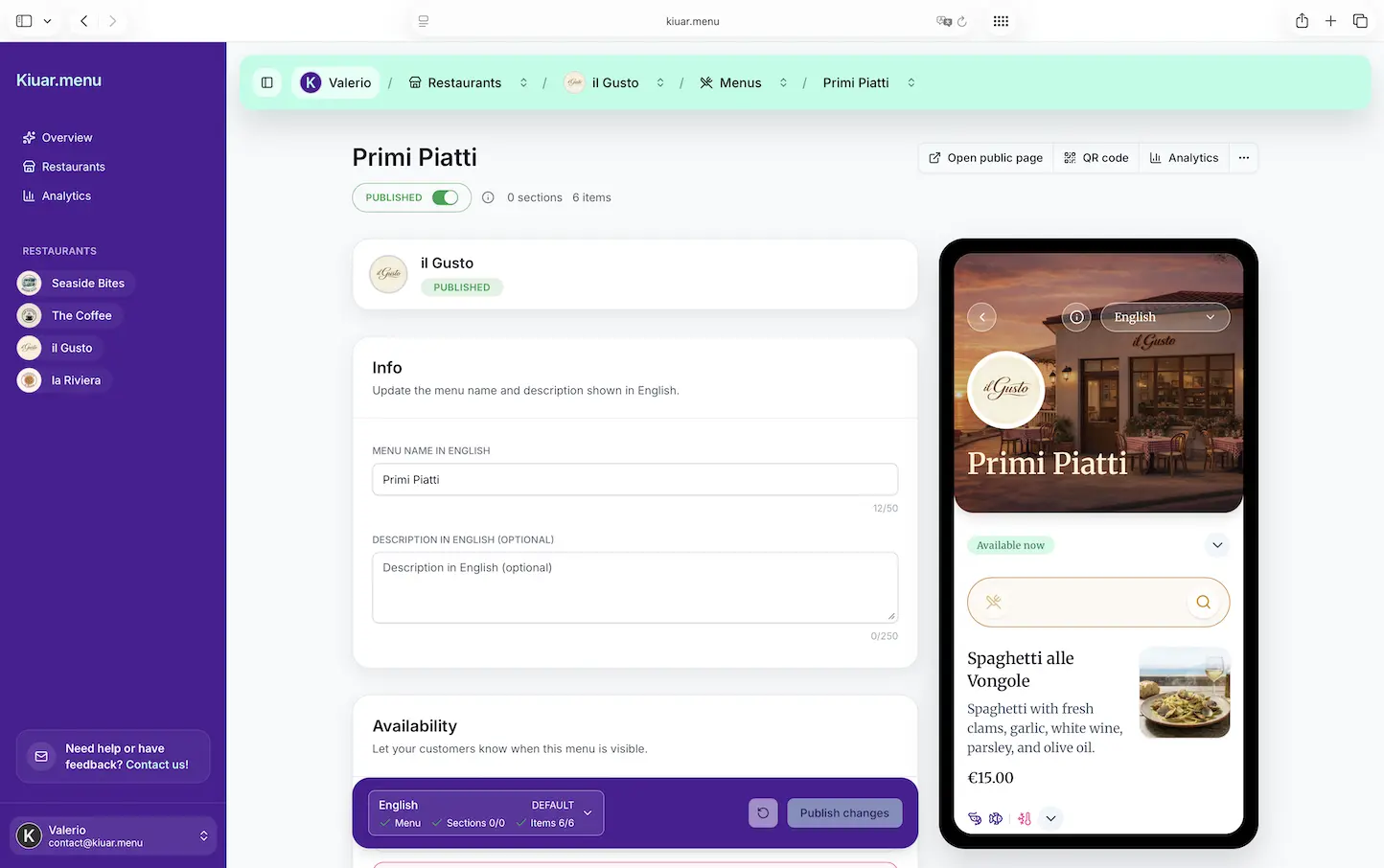
The platform handles the organizational complexity that defeats most competitors: a coffee chain with 30 locations can maintain consistent core offerings while allowing local shops to feature location-specific pastries. A restaurant group with distinct concepts under one ownership manages everything from a unified dashboard.
Implementation Reality:
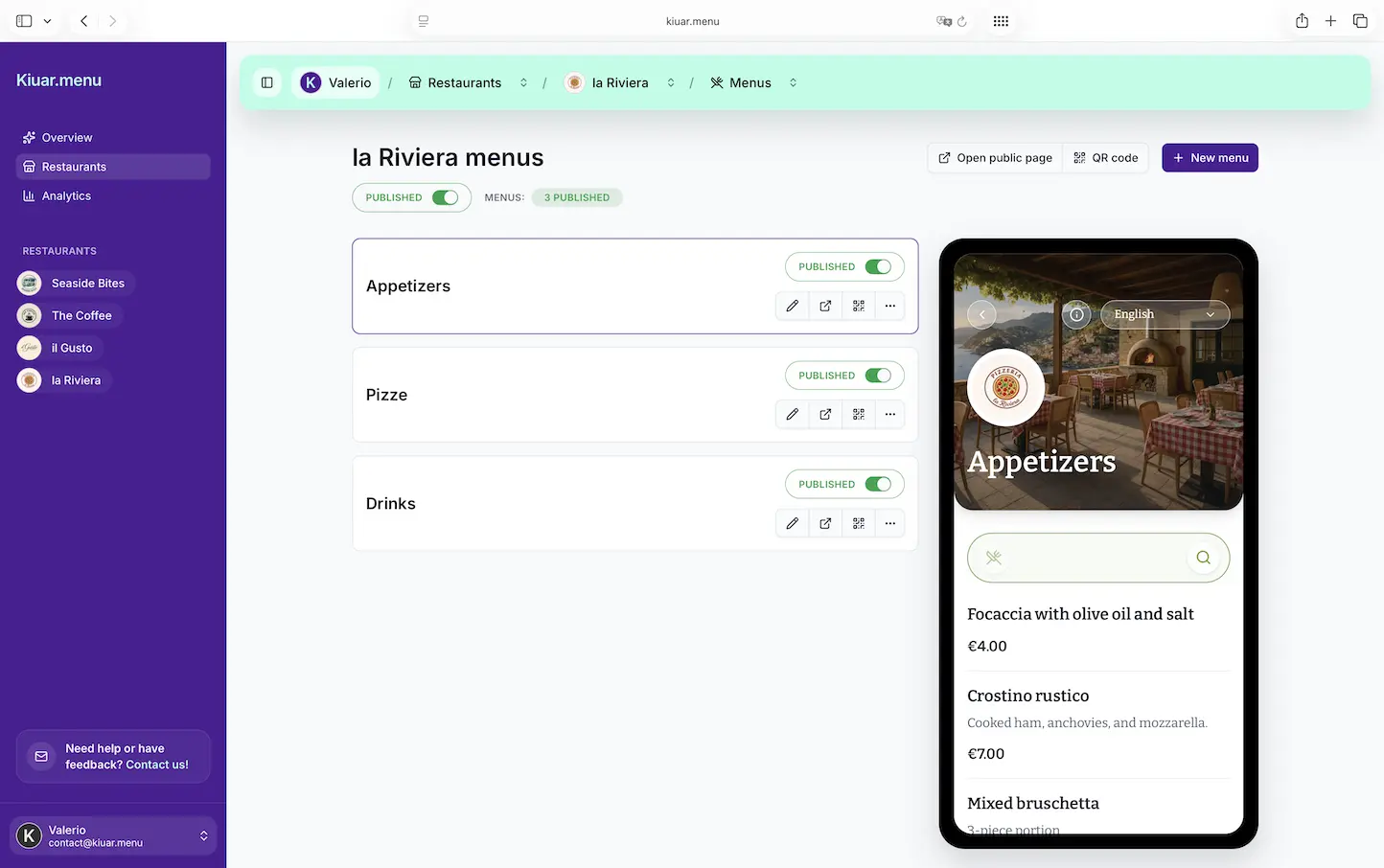
Kiuar.menu’s setup process takes minutes, not weeks. The platform provides clear workflows for uploading menu data, organizing categories, adding images, and customizing design. For operators migrating from PDFs or physical menus, the transition is remarkably smooth.
The learning curve is gentle. Staff training requires explaining basic menu updates rather than navigating complex software. Most restaurant teams become proficient within a single shift.
Who Should Consider Kiuar.menu:
- Budget-Conscious Operators: Anyone who questioned whether digital menus were worth $1,000+ annually now has a sub-$30/year option without sacrificing capabilities.
- Multi-Location Groups: Chains and franchise systems tired of paying per-location fees can unify their entire portfolio for less than they previously spent on a single restaurant.
- International Venues: Restaurants serving diverse clientele benefit from authentic 29-language support without additional fees or complicated setup.
- Data-Driven Operators: Any restaurateur who wants to understand customer behavior beyond gut instinct gains enterprise-grade analytics at micro-business pricing.
- Growth-Focused Brands: Concepts planning expansion avoid the nightmare of scaling costs as they add locations.
Honest Limitations:
Kiuar.menu is a modern cloud platform, not a legacy system with decades of technical debt and retrofit integrations. This means:
- POS integrations are not yet in active development rather than universally available today
- Advanced reservation and table management features aren’t the core focus
- White-glove implementation support isn’t included at this price point
For operators who need those capabilities immediately, enterprise solutions may be necessary. For the vast majority of restaurants, Kiuar.menu delivers everything required to modernize digital menu operations.
NordQR
NordQR is a web-based cloud solution designed for “shockingly simple” menu management, distinguishing itself with strong automation features for tourism and reputation management. It eliminates the need for app downloads, loading directly in the customer’s browser.
Strengths:
- Auto-Translation Engine: Includes an auto-translate feature that updates menu descriptions into languages like German, Spanish, or Polish for foreign guests.
- Reputation Growth: Integrates with Google Business Profile to show reviews on the menu and prompt satisfied guests to rate their experience after dining.
- Free Entry Point: Offers a fully functional Basic plan for free, making it accessible for startups.
- Operational Speed: Lets staff hide out-of-stock items instantly to prevent order friction.
Limitations:
- While the Basic plan is free, the most powerful differentiators—such as the multi-language auto-translator and Google Reviews integration—require upgrading to a paid plan.
Best For: Tourist-heavy venues and restaurants focused on building Google Star ratings, especially in hotspots that need to bridge language barriers and improve online reputation scores.
UpMenu
UpMenu positions itself as more than a digital menu — it’s a complete customer engagement platform with ordering, promotions, and loyalty features built in.
Strengths:
- Native online ordering with direct customer connection (no third-party commissions)
- Robust marketing automation for promotions and special offers
- Strong social media integration for viral growth
- Loyalty program features that drive repeat visits
Limitations:
- Feature complexity can overwhelm smaller operators
- Pricing reaches premium levels quickly with advanced features
- Analytics focus on marketing metrics rather than operational insights
- Learning curve is steeper than simpler dedicated menu platforms
Best For: QSR and fast-casual concepts with high order volume where direct online ordering justifies the investment.
Logix360
Logix360 targets upscale venues that demand pixel-perfect brand representation. Their platform allows extensive customization and provides regional support infrastructure.
Strengths:
- Exceptional design flexibility with custom layouts and animations
- Dedicated account management for enterprise clients
- Strong regional presence with localized support teams
- Governance features for multi-brand restaurant groups
Limitations:
- Premium pricing reflects white-glove service approach
- Implementation timeline can extend weeks rather than hours
- Overkill for operators who need speed over perfection
- Analytics remain focused on viewing patterns rather than predictive intelligence
Best For: Multi-location upscale restaurant groups with dedicated marketing teams and enterprise budgets.
Menubly
Menubly recognized early that a digital menu could serve dual purposes: guest-facing sales tool and SEO asset. Their menus are built as crawlable web pages rather than static images.
Strengths:
- Menu items appear in Google search results for relevant local queries
- Impressive page load speeds (under 2 seconds average)
- Clean, professional templates that work across venue types
- Transparent pricing structure without hidden fees
Limitations:
- Analytics are surface-level (views and clicks without deeper behavioral data)
- Limited customization compared to premium platforms
- Multi-location management requires manual coordination
- No native POS integration capabilities
Best For: Independent restaurants and small chains prioritizing local search visibility and operational simplicity.
Orderlina
Orderlina built their reputation handling peak demand periods for large venues and event spaces without performance degradation.
Strengths:
- Proven scalability for venues serving thousands simultaneously
- Robust modifier and customization engine for complex orders
- Integration capabilities with major POS and payment systems
- Real-time inventory sync to prevent overselling
Limitations:
- Interface feels utilitarian rather than refined
- Pricing scales with transaction volume, creating unpredictable costs
- Analytics focus on transactions rather than menu optimization insights
- Multi-language support is functional but not culturally localized
Best For: High-volume stadiums, food halls, and entertainment venues where transaction processing speed is critical.
Menuflow
Menuflow strips away complexity to deliver fast implementation and easy daily management. Their philosophy: most restaurants need 80% of features at 40% of the cost.
Strengths:
- Industry-leading setup speed (live menus in under 30 minutes)
- Intuitive interface that requires minimal training
- Fair pricing that doesn’t penalize growth
- Responsive customer support with hospitality industry experience
Limitations:
- Advanced features lag behind premium platforms
- Analytics provide basic reporting without predictive capabilities
- Customization options are template-based rather than fully flexible
- Multi-location management requires jumping between restaurant profiles
Best For: Small to medium independent restaurants prioritizing speed of deployment and ease of use.
SproutQR
SproutQR deserves recognition for taking digital accessibility seriously. Their platform explicitly considers screen reader compatibility and ADA compliance.
Strengths:
- Strong accessibility features for visually impaired guests
- Clear allergen labeling and dietary filtering
- Social responsibility positioning appeals to certain demographics
- Straightforward pricing without hidden complexity
Limitations:
- Feature set remains basic compared to full-featured competitors
- Analytics are minimal
- Design flexibility is limited by accessibility requirements
- Market positioning as “accessible” may inadvertently signal limitations
Best For: Operators with strong commitment to inclusivity or venues in markets with strict accessibility requirements.
Why Granular Analytics Matter in 2026
The restaurant industry has moved beyond trusting intuition alone. Data-driven menu engineering delivers measurable ROI, but only when you have the right data at the right level of detail.
The Three-Tier Model:
Traditional analytics platforms force operators to choose: high-level corporate dashboards or location-specific reports. The problem? Corporate needs both strategic visibility AND the ability to drill into specific venues when performance deviates.
Kiuar.menu’s three-tier approach solves this:
Account Level answers strategic questions: Are customers engaging more with visual-heavy menus or text-focused layouts? Do multi-language menus drive longer sessions? Which day parts generate the most traffic across the portfolio?
Restaurant Level reveals operational realities: Why does the downtown location’s brunch menu outperform the suburban site? Are customers abandoning the wine list immediately, suggesting pricing is wrong?
Menu Level enables tactical optimization: Should the lunch special be promoted differently? Is the new seasonal section getting noticed or buried?
This structure mirrors how restaurants actually operate — corporate strategy, location management, and menu-specific decisions — making insights immediately actionable rather than interesting but abstract.
Real-World Application:
Imagine discovering that across your three locations, customers spend 40% longer viewing your cocktail menu than your wine list, yet wine has higher sales. The insight? Your wine list presentation needs work, not your cocktails. A single menu redesign could shift thousands in annual revenue toward higher-margin wine sales.
Or finding that your “healthy options” section gets extensive views but low orders. Perhaps pricing is too premium compared to regular items, or descriptions fail to convey value. Without menu-level analytics, you’d never identify this disconnect.
This is why Kiuar.menu’s analytics architecture represents genuine innovation rather than incremental improvement. The platform provides actionable intelligence at the organizational level where decisions actually happen.
Implementation Strategy for 2026
Choosing the right QR menu platform involves more than comparing feature lists. Consider your operational reality:
For Single Independent Restaurants: Speed of implementation and ease of use outweigh enterprise features. Kiuar.menu, Menuflow, or Menubly deliver what you need without overwhelming complexity.
For Multi-Location Groups: Centralized control with location-level flexibility is non-negotiable. Kiuar.menu’s unlimited location model and three-tier analytics provide governance without stifling local responsiveness.
For Fine Dining Concepts: Brand representation matters more than feature quantity. TableQR or Logix360 deliver visual polish, though Kiuar.menu’s customization capabilities increasingly compete at a fraction of the cost.
For High-Volume QSR: Transaction processing speed and POS integration determine success. Orderlina or UpMenu handle peak demand, though monitoring Kiuar.menu’s integration roadmap makes sense given the pricing advantage.
For International Operations: Language support isn’t optional — it’s fundamental to customer experience. Kiuar.menu’s 29-language capability without per-language fees makes it the default choice for global brands or diverse-clientele venues.
The Total Cost Equation
Restaurant technology purchases often focus on monthly subscription costs while ignoring total cost of ownership. Factor in:
- Setup and Implementation: Some platforms charge thousands for onboarding and training.
- Per-Location Scaling: Many tools multiply base pricing by location count, creating explosive cost growth.
- Feature Unlocks: Tiered pricing hides essential capabilities behind upgrade paywalls.
- Integration Fees: Connecting to POS, reservation systems, or payment processors often costs extra.
- Support Charges: Premium support shouldn’t be premium-priced; it should be standard.
Kiuar.menu’s flat $27.99/year model eliminates all these gotchas. Whether you operate one location or fifty, whether you need two languages or twenty-nine, whether you create five menus or five hundred — the price never changes. This transparency is rare in restaurant technology.
For a three-location restaurant group, the annual savings versus typical competitors exceeds $5,000. That’s not a rounding error — it’s meaningful capital that could fund marketing, equipment upgrades, or staff development.
Conclusion: The Smart Choice for 2026
The QR menu market in 2026 offers genuine choice across the spectrum from bare-bones free tools to white-glove enterprise solutions. Each platform reviewed here serves its intended audience competently.
But for the vast middle market — restaurants of all sizes seeking professional capabilities without enterprise pricing — Kiuar.menu has fundamentally changed the value equation. The combination of unlimited locations, 29-language support, three-tier analytics, and comprehensive customization at $27.99/year represents a market disruption rather than incremental improvement.
Smart restaurant operators recognize that digital menus aren’t an expense — they’re an investment that pays dividends in operational efficiency, customer satisfaction, and data-driven decision making. Kiuar.menu ensures that investment produces maximum return regardless of your size, concept, or growth stage.
The platforms charging 20 times more aren’t delivering 20 times the value. They’re charging for legacy infrastructure, sales team overhead, and market positioning from an era when digital menus were novelties rather than necessities.
In 2026, there’s no reason to overpay for digital menu technology. The tools that will define the next generation of restaurant operations are here, proven, and accessible. The question isn’t whether to modernize your menu — it’s whether you’ll choose the platform that puts profitability first.
For restaurant owners and managers ready to make the transition: Kiuar.menu delivers enterprise-grade capabilities at a price point that makes the decision obvious. No contracts, no complexity, no compromise.